All Blogs
What Is a Good ATS Score? (And What the Number Really Means)
An 80+ ATS score is good, but the number isn't a grade. Here's what each score range means and why two checkers give the same resume different scores.

An 80+ ATS score is good. But the score itself doesn’t matter. A candidate scoring 70 can be far more capable than one scoring 90. It only measures two things: how cleanly software can read your resume, and how well it matches one specific posting. That gap is the whole problem. In Harvard Business School's Hidden Workers study, 88% of employers said qualified, high-skilled candidates get filtered out because they don't match the exact criteria in the job description.
And here’s the thing people get wrong: they treat the score like a grade the hiring system gave them. It didn’t. The ATS doesn’t score your resume at all – the ATS resume checker tool you ran it through does. Every tool works a little differently, so the same resume can score 72 on one and 85 on another.
So this guide breaks down what a good score really looks like, what each score range means, and why keyword-match rate and a full ATS can tell you two very different things.
TL;DR
Short answer: 80+ is good. 90+ means the resume is clean. But the number is one checker's opinion, not the employer's — the same resume scores differently on different tools depending on what each one measures. Use the range, not the number: 60–79 is usually a keyword gap, below 60 is usually a formatting or parsing problem.
What Does an ATS Score Mean?
An ATS score isn’t one thing. It combines two separate questions into a single number.
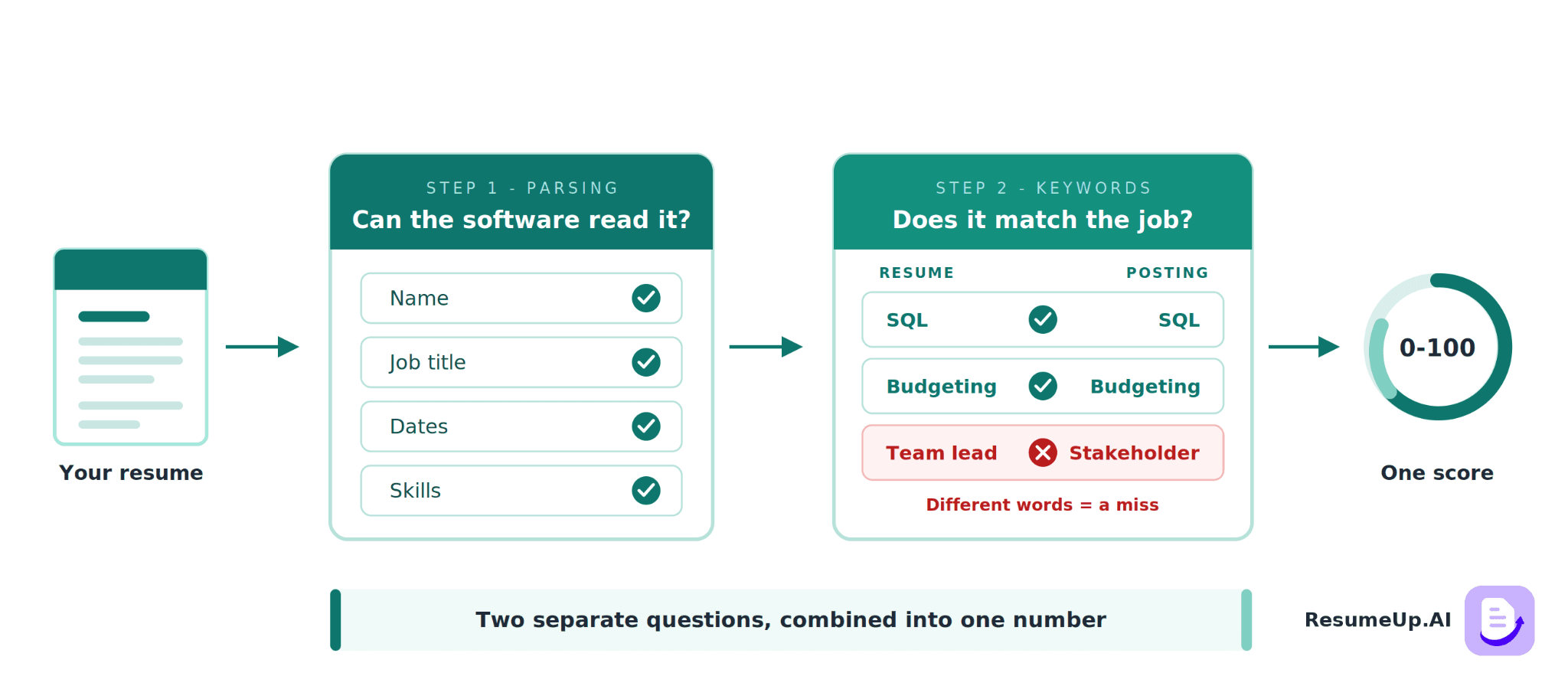
1. Can the Software Read Your Resume?
Before anything else, the system has to pull the text from your resume and sort it into fields – name, job title, dates, skills. If your layout is clean, this works. If it’s a two-column design, a table, or text inside a graphic, parts get scrambled or dropped. Starting from an ATS-friendly resume template avoids most of this. This is the “parsing” half of the score.
2. Does Your Resume Match the Job?
Then it looks at the content itself: whether the skills, tools, and job title on your resume match the posting's wording. The same experience described in different words counts as a miss. This is the “match” half.
A good score means both are working: the software reads your resume cleanly, and you match the role. A low score is just telling you which half is broken. And the score can’t see your talent, your track record, or how you’d perform in the job. It only rates the resume against one posting.
What’s a Good ATS Score (Range by Range)
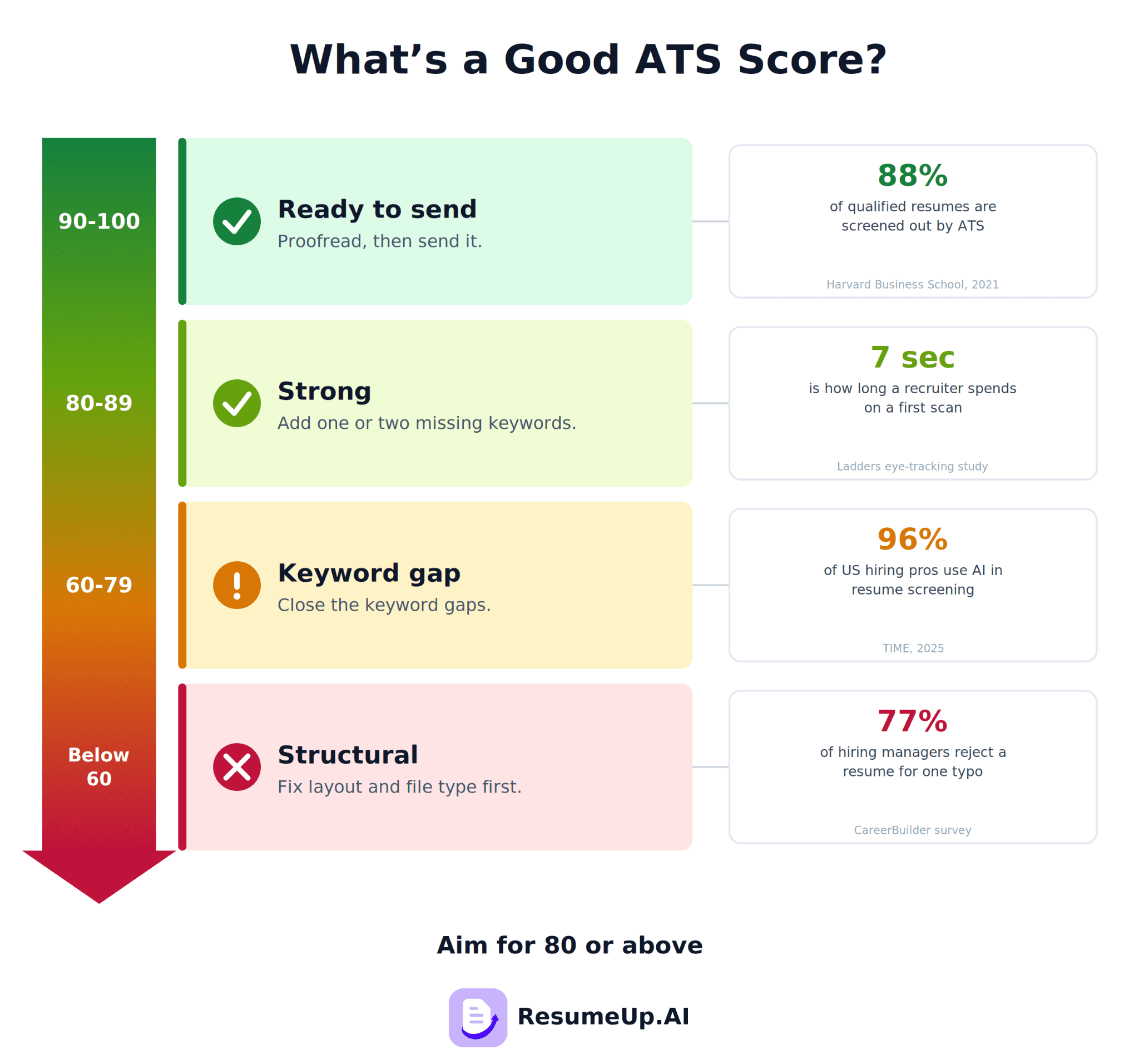
Most ATS checkers put a strong resume above 80. But the range you land in tells you more than the exact number, because each one points to a different fix.
Score | What it means | What to do |
90-100 | Reads cleanly and closely matches the job. Nothing obvious missing. | A final proofread, then send it. |
80-89 | Strong. Small keyword gaps or minor formatting nits. | Add one or two missing keywords and send. |
60-79 | Usually a keyword gap, not a formatting one. You have the experience, but you described it in different words than the posting. | Check the flagged terms and work the real ones into your skills and bullets. |
Below 60 | Usually structural – the tool couldn’t read parts of your resume, or the role doesn’t match your background. | Fix layout and file type first, then keywords. |
Already know what your number means and just want to run the check? Here's how to check your ATS score in about a minute.
Why the Same Resume Scores 73 on One Tool and 86 on Another
Run one resume through two ATS checkers, and you’ll often get two very different numbers. That isn't a glitch, and it doesn’t mean one tool is wrong. It means they measured different things.
Some checkers care most about whether the software can read your resume. Others care most about whether your words match the job posting. Some won’t give you a score until you paste in a job description. Others never ask for one, because they’re only grading the resume by itself.
They also disagree on what counts as a problem. One might flag a bullet point with no numbers in it. Another skips bullets completely and checks your section headings instead.
And the scores aren’t even on the same scale. One tool says 73%, and the other says 86. Putting those numbers next to each other is like comparing Celsius to Fahrenheit. So your ATS resume score isn’t a fixed fact about your resume. It’s one tool’s opinion, based on what that tool decided to check. Use a different tool, and you’ll get a different number.
Here’s what that looks like in practice.
Checker A | Checker B |
 | 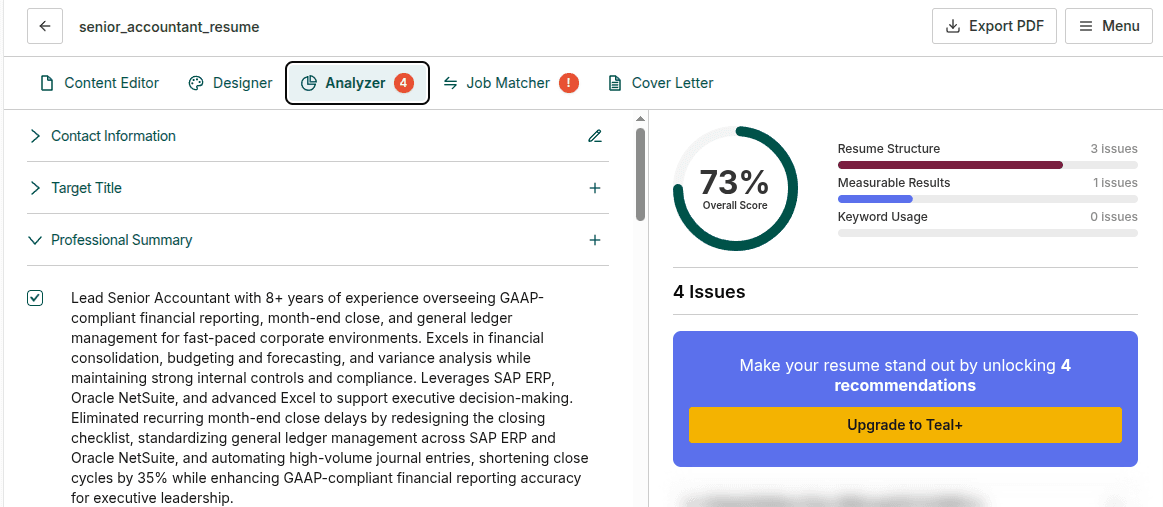 |
In August 2026 I ran the same resume through two of the most-used public ATS checkers on the same day. One returned 86 out of 100. The other returned 73% — a match rate, not a score out of 100, which is the first reason the numbers can't be compared.
The second is the setup: the 86 had the job description pasted in, so it scored the resume against a specific role. The 73% had no job attached, so it only graded the resume itself. Two tools, two questions, two numbers.
Keyword-Match Rate vs Full ATS Check
A keyword match compares your resume to one job posting. It looks for the skills, tools, and job title in that posting and checks whether they appear in your resume. Paste in a different posting, and the number changes even though you didn’t touch your resume.
A full ATS check looks at the resume itself. Can the software pull out the name, dates, job titles? Are your section headings ones it recognizes? Is the file type readable? None of this has anything to do with a specific job.
Keyword Match | Full ATS Check | |
Compares | Your resume to one job posting | Your resume to itself |
Catches | Missing skills, tools, titles | Broken layout, unreadable text, missing dates or contact info |
Misses | Whether the software can read you at all | Whether you fit this job |
Changes When | You change the posting | You change the resume |
Best For | Tailoring one application | Building a base resume |
Some tools do both. ResumeUp.AI runs 28 checks on the document itself – parsing, headings, bullets, dates – and matches it against the posting. Under the score, you get the actual report: what’s wrong, and one-click fixes. It also flags the same keyword repeated too many times, which is the mistake people make when they’re chasing a higher number.
That’s the part that matters. The ATS score tells you something’s off. The breakdown tells you what, and lets you fix it.
What the 28 Checks Actually Look at
The 28 checks fall into 4 groups, and each one answers a different question.
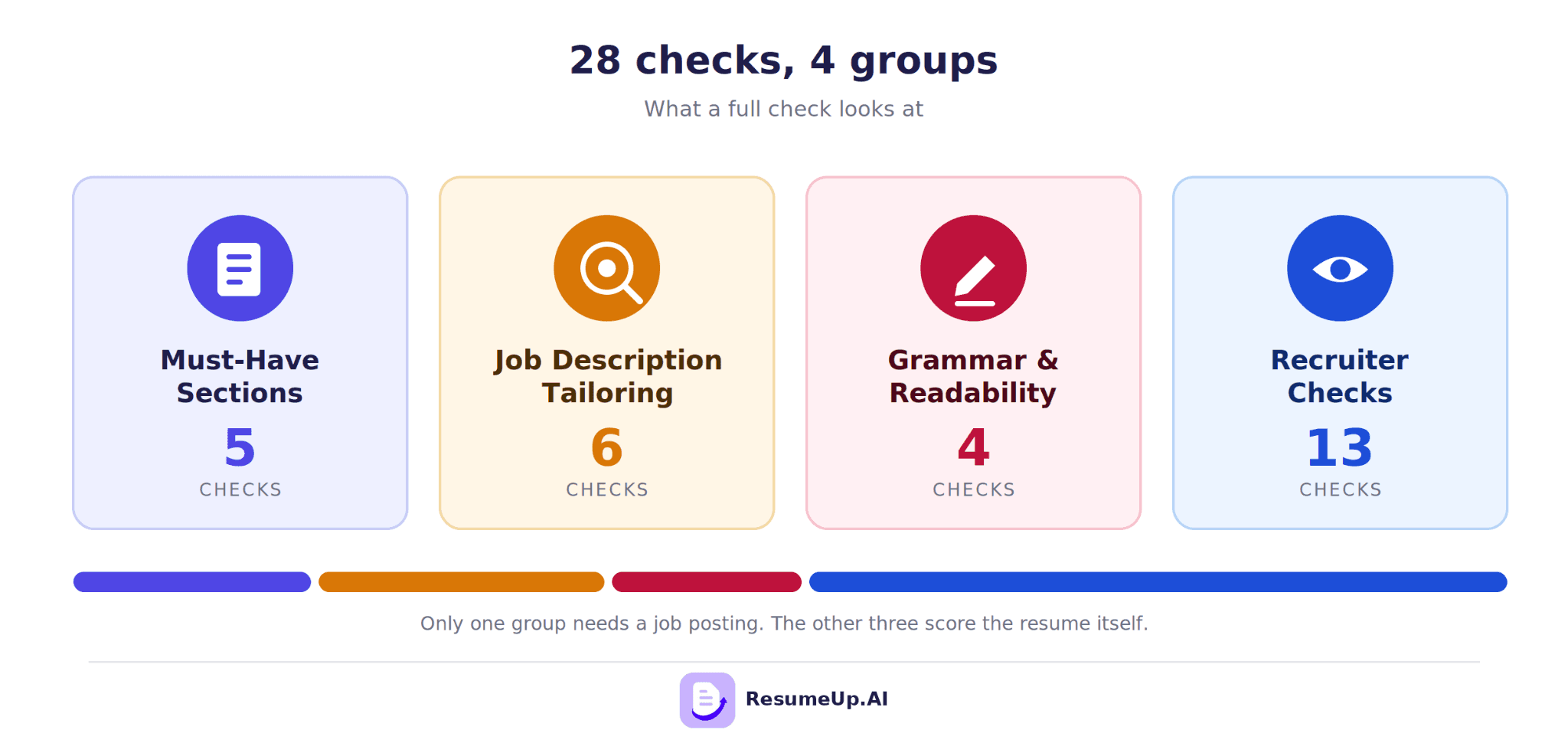
Must-Have Sections (5 Checks)
Does your resume have the parts ATS and recruiters expect, under the name they use?
Personal information as a readable contact block
A professional summary
A skills section structured so it can be extracted
Work experience in reverse chronological order
Education in reverse chronological order
Job Description Tailoring (6 Checks)
This is the Keyword-Match rate part. Every hard skill in the posting gets counted against your resume, then the same for soft skills. It also checks the hard requirements – degree, years of experience, job title alignment – which is where a lot of silent rejections come from. You can use a job description keyword finder to get the keywords without missing anything.
Grammar & Readability (4 Checks)
Once you clear the ATS, a recruiter’s first scan takes about 7 seconds on your resume, according to Ladders' eye-tracking study. This is the part that decides how those seconds go.
Passive voice – “was responsible for managing the budget” instead of “managed a $4M budget”
Bullet density – 3 to 6 per role is the range
Sentence readability, so long and heavy lines get flagged
Recruiter Checks (13 Checks)
These are the issues a senior recruiter catches in the closer 30-second read that follows.
Contact completeness – name, phone, professional email, LinkedIn URL, city and state, all readable in the body
Headline and summary: two things recruiters read first
Action verbs – every bullet should start with one
Measurable results – "grew Instagram following 247% in 9 months," not "responsible for managing social media"
Style flags for buzzwords, overused phrases, and personal pronouns
Frequently Asked Questions
What ATS score do I need to get an interview?
No cutoff guarantees anything. 80 or above means your resume is parsable and aligned with the posting, but the score doesn’t decide whether you get called.
Do companies actually reject resumes based on score?
Not the score from a checker tool. That number never reaches the employer. What can hurt you is the underlying problem the score is pointing at, like a section the ATS couldn’t read or missing keywords that keep you out of a recruiter’s search results.
Is a 70 ATS score good?
It’s workable, not strong. A 70 usually means the software reads your resume fine, but you described your experience in different words than the posting used. That’s a wording gap, not a skills gap, and it’s the quickest kind to fix – work the posting’s actual terms into your skills section and bullets.
Do I need to check my score for every job I apply to?
Only the matching half. Get the document itself clean once — that part carries across every application. After that, re-check the keyword match each time you target a new posting.
How do I get a 90+ ATS score?
Fix the document first, then the match.
Clean, single-column layout with no text trapped in graphics
Standard section names — Summary, Work Experience, Skills, Education
Contact block readable in the body of the resume
Dates in reverse-chronological order
Then paste in the posting and close the keyword gaps, using the exact terms the job uses
Why did my score drop when I applied to a different job?
Because half of the score is measured against the posting. Change the posting and the keyword half changes with it, even though the resume is identical. The resume half – parsing, headings, dates – stays the same.

Rohith Reddy
Co-Founder
Rohith Reddy is the co-founder of ResumeUp.AI and a former hiring manager who conducted 500+ technical interviews over a decade at companies including ADP. His hiring-market research at ResumeUp — including studies on ghost jobs and AI's impact on entry-level hiring — has been covered by Entrepreneur. A Computer Science graduate, he writes about what recruiters and ATS systems actually reward, from both sides of the hiring table.